

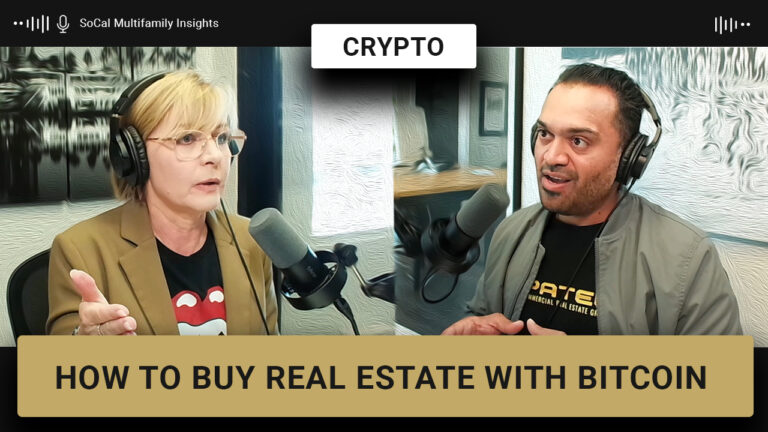
When you think of buying real estate, the traditional route usually involves mortgage lenders, wire transfers, and stacks of paperwork. But in a rapidly evolving digital economy, there’s a growing number of buyers using an entirely different currency—cryptocurrency—to purchase property. And leading the charge is Piper Moretti, founder of The Crypto Realty Group, who has closed millions in real estate transactions using Bitcoin and other digital assets.
We recently sat down with Piper on the SoCal Multifamily Insights podcast to discuss how crypto is transforming the real estate landscape, what agents need to know, and why buyers with digital wallets might be your next clients.
From Manhattan Beach to Crypto Real Estate Pioneer
Piper’s journey into crypto real estate began by accident. A year and a half into her career as a real estate agent, she was contacted by a buyer looking to purchase a home in Manhattan Beach. After a few property tours, he casually mentioned that he intended to make the purchase using Bitcoin. At the time—this was back in 2016—this was uncharted territory.
Piper, like most of us at that time, had never heard of anyone actually using crypto to buy a home. She called everyone she knew for advice—lenders, escrow agents, even friends in tech. Nobody had answers. With no blueprint to follow, they essentially “built the plane as it was flying.” Eventually, the seller accepted the offer after a rather unconventional “proof of funds” process (which involved a selfie with a crypto wallet on screen), and the deal went through. That transaction was among the first Bitcoin real estate deals in California.
Word quickly spread. Piper went on to complete three more crypto transactions that same year and began building a reputation as a trusted expert in the space. She even spoke at a Blockchain Association conference in New York, where she realized she was far ahead of the curve.
How a Crypto Real Estate Deal Works
The natural question that follows is: How does this all work?
According to Piper, a crypto real estate transaction looks surprisingly similar to a cash deal—once you get past the initial steps.
It starts with KYC (Know Your Customer) and AML (Anti-Money Laundering) procedures. These are standard in the finance world and are essential for confirming the buyer’s identity and ensuring their crypto isn’t coming from suspicious or illegal activity.
Once the buyer is vetted, Piper’s team can issue a proof of funds letter within 48 hours. From that point, the process is treated like a cash deal, often with a twist: the buyer sends their Bitcoin through a secure link, where the price is locked in at that moment and instantly converted to U.S. dollars. That cash is then deposited into the escrow account.
Escrow companies like Guaranteed Escrow (whom Piper frequently works with) are equipped to handle these transactions seamlessly.
Addressing the Volatility
One of the biggest concerns about using crypto in real estate is volatility. What if Bitcoin crashes mid-escrow? Piper addresses this by having buyers convert their crypto early in the process—or lock in the price at the time of transfer. One buyer even chose to convert his assets two weeks before closing when he saw the market turning south in 2018. He avoided a significant loss, and the deal closed smoothly.
Collateralized Crypto Loans
What if you don’t want to sell your Bitcoin but still want to use its value to buy property? Piper discusses how collateralized crypto loans are a growing trend. Companies like Milo Credit offer products that allow crypto holders to leverage their assets for loans of up to 70% loan-to-value (LTV), often without triggering a taxable event.
The crypto is held in cold storage as collateral, and the borrower receives U.S. dollars to use however they like—including buying real estate. It’s a win-win for those who believe in long-term crypto growth but also want to invest in stable, appreciating assets like property.
Stablecoins vs. Bitcoin in Real Estate
While Bitcoin gets all the attention, stablecoins (like USDT or USDC) are often preferred in real estate transactions because their value is pegged to the U.S. dollar. That means no wild price swings, and smoother transactions. Piper says she’ll gladly accept stablecoins any day, as they combine the convenience of crypto with the predictability of fiat currency.
Tokenization and the Future of Syndications
Toward the end of our conversation, Piper touches on a particularly fascinating topic: tokenized real estate. Companies like Blocksquare are leading efforts to tokenize property ownership, making it possible to sell fractional ownership via digital tokens.
This opens the door for micro-investing, allowing everyday people to own part of a property—even with just a few hundred dollars. These tokens can be traded, and ownership is often governed by smart contracts and DAOs (Decentralized Autonomous Organizations). It’s a futuristic vision that blends blockchain with real estate syndication and community ownership.
Should You Convert Crypto Into Real Estate?
Piper’s advice to those sitting on substantial crypto gains is clear: Real estate is still the most stable asset class you can own, especially in Southern California. Using crypto to purchase income-producing property not only diversifies your holdings but also puts you on a path toward long-term wealth.
While you may want to keep some crypto for the upside potential, converting a portion into tangible real estate can provide steady cash flow, tax advantages, and peace of mind.
The Bottom Line
Piper Moretti has helped close over $32 million in crypto-funded real estate deals, and she’s just getting started. From navigating early uncertainty to building a process that’s now proven and scalable, she’s helping reshape how we think about property purchases.
Crypto may not replace traditional financing just yet, but it’s already proving to be a powerful alternative—especially for early adopters with significant digital assets.
To learn more or work with Piper, visit www.cryptorealtygroup.com or email her at piper@cryptorealtygroup.com.
Interested in using your crypto to invest in multifamily or hospitality properties?
Contact Jack Patel today to learn how you can grow your wealth through strategic acquisitions and 1031 exchanges in Southern California.
How to contact Piper
Piper Moretti, The Crypto Realty Group